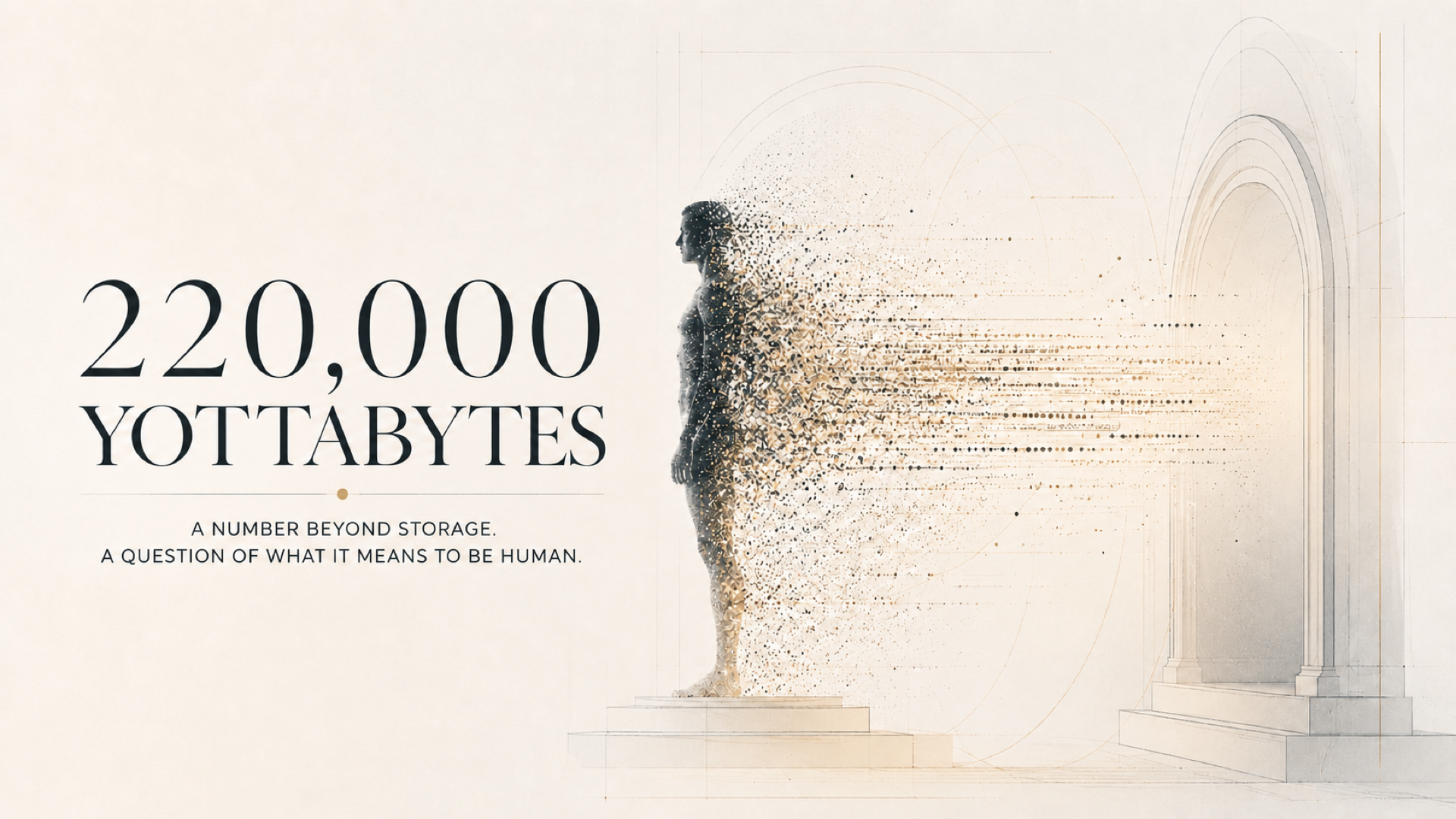
220,000 Yottabytes
A number beyond storage. A question of what it means to be human.
As a devout Star Trek nerd, I often find myself giving fictional technologies far more serious thought than they probably deserve.
Recently, I have been thinking about planetside, terminal-to-terminal transporters. Not the dramatic kind that plucks someone from a hostile planet and deposits them on the bridge, but something closer to public infrastructure: fixed terminals connected through a dedicated network, moving people between known locations.
There are many holes we could disappear into here. Energy requirements. Pattern buffers. Annular confinement beams. Whether transport counts as travel, duplication, or an exquisitely managed death.
I will spare you and Alice those particular tunnels for now.
The question that stayed with me was simpler:
How much space would it take to convert one human being from solid matter into a data stream?
A typical human body contains roughly seven octillion atoms. If a transporter needed to record the identity, position, momentum, bonding state, and reconstruction instructions for each of them, even a deliberately conservative estimate becomes almost incomprehensible.
Assume just 256 bits per atom.
That gives us approximately 1.8 × 10³⁰ bits, or around:
220,000 yottabytes.
That is 220 billion exabytes.
At the scale of today’s largest storage systems, preserving the pattern of one person could require hundreds of billions of data-center-scale installations. Not a city of servers. Not a continent of them. Something closer to an industrial civilization built around the temporary storage of a single passenger.
The arithmetic is speculative, of course. A real transporter might not convert a person into ordinary digital information at all. It might preserve matter in some coherent physical state, using a pattern buffer less like a hard drive and more like a temporary fold in reality.
That is where the scientific exercise ends.
The more human question begins.
Imagine a person broken down into information and transmitted at the speed of light from one terminal to another, routed through infrastructure much as a late-twentieth-century phone call passed through exchanges, trunks, switches, and cables.
You step into a terminal in Meridian. The system reads you, disassembles you, routes you through the network, and reconstructs you somewhere else.
For a fraction of a second, you are not standing anywhere.
You are in transit.
Not as a body moving through space, but as a pattern being carried through a system.
We tend to talk about human beings as though they are already manageable collections of data. A date of birth. A medical record. A credit score. A résumé. A voting history. A set of preferences inferred from clicks, purchases, locations, and pauses.
Institutions compress people because institutions must. No hospital, government, employer, or machine-learning model can contain the totality of a human life.
The problem begins when we forget that compression has occurred.
A medical record is not a patient. A criminal record is not a person. A résumé is not a career. A demographic category is not a community. A behavioral profile is not a self.
Each is a functional reduction, useful for a particular purpose and dangerous when mistaken for the whole.
The theoretical transporter makes this difference impossible to ignore.
To reconstruct a person, it would not be enough to know that they are fifty-two years old, five feet eleven inches tall, left-handed, and prone to disappearing into speculative essays about public transportation in the twenty-fifth century.
It would need everything.
Every scar. Every neural connection. Every chemical gradient. Every cell in the middle of dying or dividing. Every electrical impulse still moving through the brain. Every microscopic structure carrying some part of memory, temperament, illness, habit, grief, affection, and identity.
Even 220,000 yottabytes may only describe the body.
It may not fully describe the person.
That distinction matters far beyond science fiction.
We are entering an era in which more decisions about human beings will be made through representations of them. Models will assess risk. Algorithms will predict behavior. Systems will determine eligibility, credibility, employability, safety, and need.
These systems will not encounter people directly.
They will encounter compressed versions of people.
The moral question is not whether compression can be avoided. It cannot. The question is whether we remain conscious of what has been lost.
Technology often measures its progress through scale: more storage, more bandwidth, more parameters, more precision. The transporter fantasy pushes that logic to its extreme. Give the system enough capacity, and perhaps reality itself can be recorded, routed, and restored.
Yet the number that matters may not be the capacity of the system.
It may be the distance between the record and the life it claims to represent.
A person may require 220,000 yottabytes to describe at atomic resolution. We routinely make consequential decisions about that same person using a few hundred fields in a database.
The achievement of future technology may be its ability to carry more information.
The measure of a humane civilization will be whether it remembers that no representation, however detailed, is the human being standing before it.

Subscribe to Amid the Noise
Amid the Noise is an ongoing body of work on signal, systems, governance, AI, and the structures that shape human judgment under pressure.
Subscribe to receive new essays as they are published.