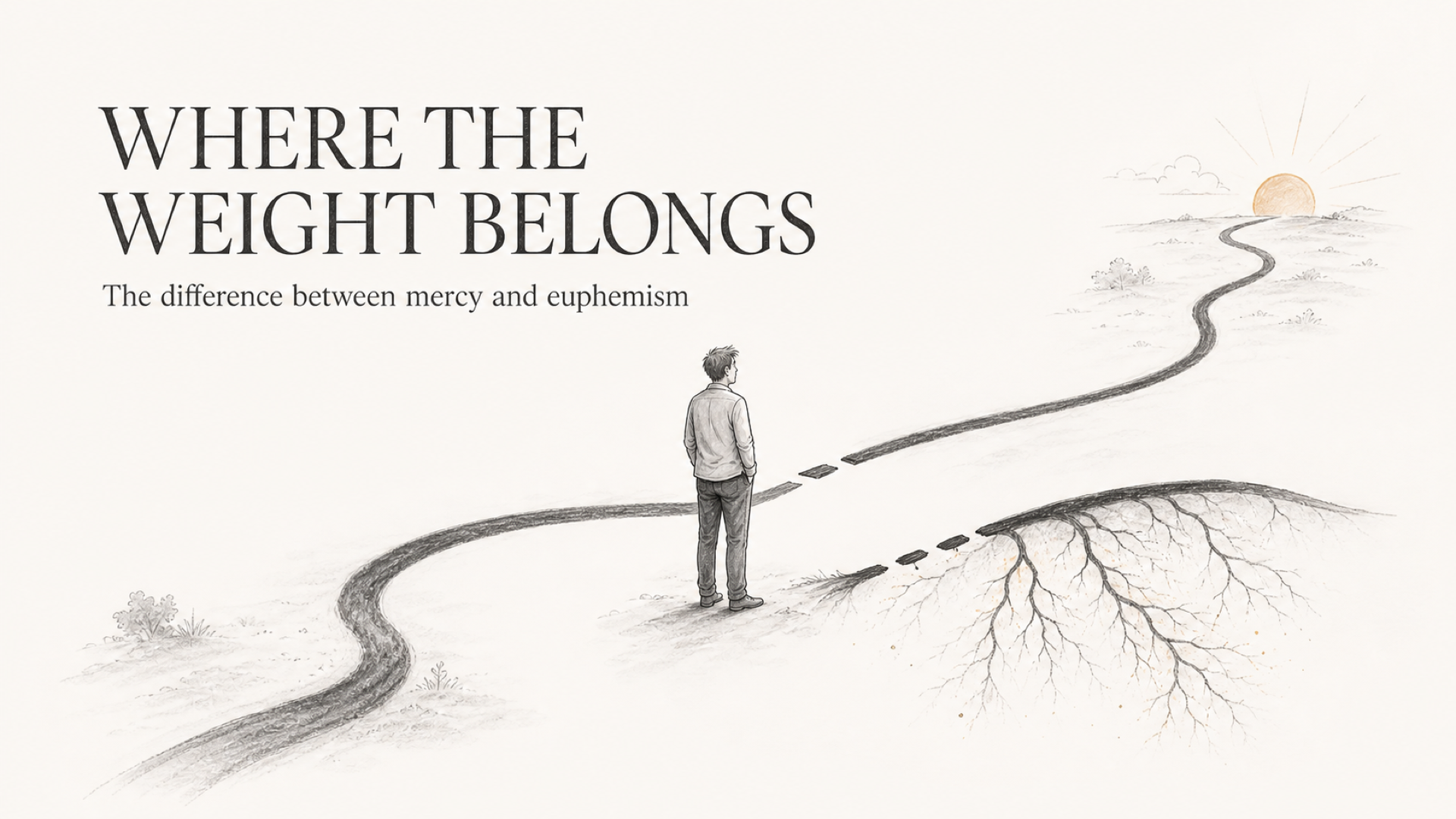
Where the Weight Belongs
The difference between mercy and euphemism
I wrote something true.
It was not the whole truth.
In “When We Rob Moments of Their Weight”, I argued that euphemism can soften reality until we no longer feel what happened. I wrote that every moment has its own weight, and that every weight deserves to be carried in truth.
I still believe that.
I was wrong about where the weight always belongs.
The interruption
I once heard relapse described as a “sobriety disturbance.”
I laughed at the phrase. It sounded institutional and evasive, as if someone had taken an event capable of destroying lives and renamed it after a neighbor’s television playing too loudly.
Then I heard a different phrase.
Sobriety interruption.
I laughed at that one too.
I should not have.
A sobriety interruption is an event.
A relapse is what happens when that interruption takes root.
Those are not two polite names for the same thing. They are two different things, requiring two different responses.
I know because the term was once used for me.
When I was being urine tested, every clean test earned a gift card. Over several months, those cards added up to almost six hundred dollars. It was my only fun money. Each clean test gave me something immediate and tangible at a time when the larger rewards of sobriety could still feel far away.
If I had failed a test, the result would not have erased every clean test that came before it. It would have created an opportunity for more outpatient care, or a conversation about whether a sobering center was the support I needed.
The test was not a verdict.
It was information.
The language worked the same way.
“Sobriety interruption” did not pretend that drinking was harmless. It prevented one incident from becoming an identity. It left room to say:
Something happened. It matters. It does not yet define what happens next.
That is not anesthesia.
That is precision.
When softer words tell the harder truth
My earlier argument treated sharpness as honesty and softness as evasion.
Sometimes that is exactly right.
“Integration” can hide forced assimilation. “Public stability” can hide institutional control. “Defense” can hide war. Gentle language can protect powerful people from the weight of what they have done.
But language can also place too much weight on the person already carrying it.
“Relapse” can turn one night into a collapse of identity. It can make every sober day feel retroactively canceled. It can tell someone standing at the edge of a difficult moment that they have already fallen all the way back down.
That is not always truth.
Sometimes it is shame pretending to be accuracy.
The distinction is not between strong words and weak words. It is between words that clarify and words that conceal.
Sometimes we soften language so shame does not swallow the person.
Sometimes we sharpen it so comfort does not swallow the truth.
What the language protects
That is the question I missed the first time.
Not: Is the language gentle?
Not: Does the language sting?
What does the language protect?
Does it protect a person from becoming identical to their worst moment?
Or does it protect a system from being identified with the harm it caused?
One is mercy.
The other is evasion.
They can sound remarkably similar from a distance.
Up close, they move the weight in opposite directions.
An event and a process
I understand the distinction now.
An interruption happened.
A relapse takes root.
An interruption deserves attention precisely so it does not become something more. It may call for honesty, support, a change in care, or simply the next right decision. None of that requires pretending the interruption did not matter.
It requires allowing it to matter in proportion.
And if it does take root, “relapse” is still not a moral judgment. It names a process that needs a response. The person has not become a failure. The support needs to become stronger.
Success deserves reinforcement.
Difficulty deserves more support.
That was the philosophy behind the gift cards, the urine tests, the outpatient care, and the possible conversation about a sobering center. It was not permissive. It was designed around the possibility of return.
I could not see that when I laughed at the phrase.
I can see it now.
The right weight
I am leaving the earlier essay where it is.
I do not want to quietly rewrite the person who wrote it. He had recognized something real: language can be used to make harm easier to tolerate. He had not yet recognized that language can also keep a mistake from becoming destiny.
Both are true.
Strong language is not always truthful.
Gentle language is not always evasive.
The most respectful thing we can do is not simply to make every word heavier. It is to place the weight where it belongs.
On the act, without burying the person.
On the system, without disguising the harm.
On the truth, without turning truth into punishment.
Words matter.
So does where we make them carry the weight.

Subscribe to Amid the Noise
Amid the Noise is an ongoing body of work on signal, systems, governance, AI, and the structures that shape human judgment under pressure.
Subscribe to receive new essays as they are published.