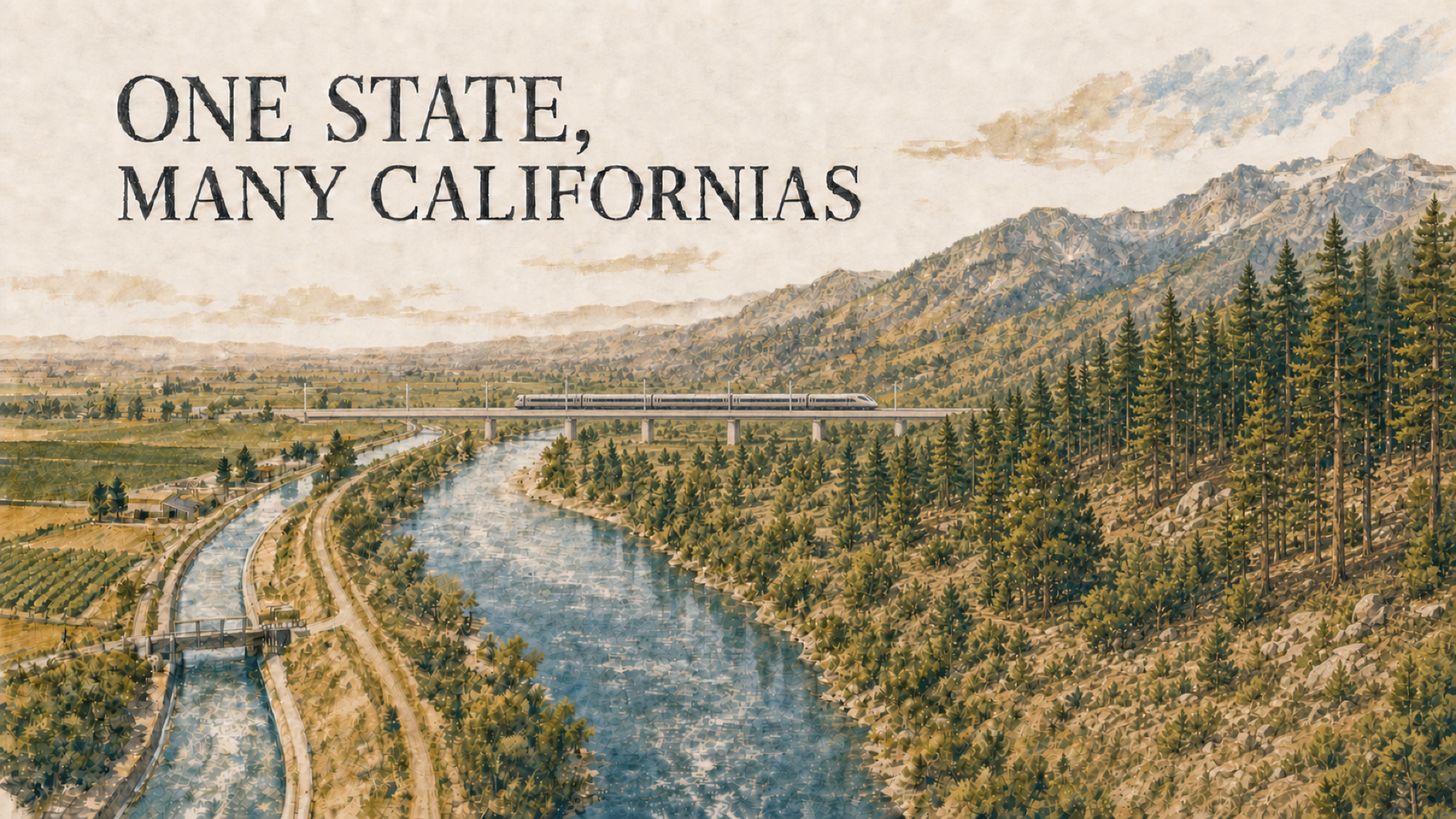
One State, Many Californias
Rushes, Infrastructure, and the Work of Stewardship
When I drive south on Interstate 5, I begin to see the signs.
CONGRESS CREATED DUST BOWL.
They stand at the edges of fields in the San Joaquin Valley, large enough to survive seventy miles an hour and simple enough to require no explanation. Farther east, in the Sierra foothills near Murphys and Sonora, another set of signs carries a different grievance: restore logging, resist Sacramento, remember Jefferson.
Neither message contains the whole truth. Both tell the truth about how government feels from the place carrying its consequences.
The signs interest me because they compress a system into an accusation. Congress did change the rules governing Central Valley water, most consequentially when the 1992 Central Valley Project Improvement Act made fish and wildlife protection a coequal purpose of the federal project and dedicated water to environmental restoration. That reduced the water available for other uses, but it did not create the dry fields by itself. Drought, groundwater overdraft, crop selection, pumping constraints, water rights, and the approaching requirements of California’s Sustainable Groundwater Management Act belong to the same account.
The logging signs perform a similar compression. Regulation changed the forest economy, but so did decades of harvesting, mill consolidation, automation, fire exclusion, commodity markets, and the exhaustion of an industrial model built around a different understanding of the forest. The decline of logging employment is real, as are the ecological costs that made reform unavoidable.
It would be easy to dismiss the signs for what they omit. It would also be a mistake.
They are evidence of a state whose aggregate successes and local consequences have drifted apart. California can build a water system that supports tens of millions of residents and one of the world’s most productive agricultural regions while leaving a farm community convinced that the state intends to erase it. California can protect forests from one form of extraction while failing to build the continuous management capacity needed for the forests that remain. California can ask voters to authorize a rail system for the twenty-first century, begin construction, and spend years teaching them to associate the project with delay rather than arrival.
California is unusually good at building in response to opportunity. Gold, agriculture, oil, entertainment, wartime manufacturing, postwar expansion, aerospace, software, and artificial intelligence each drew people and capital toward the state. Each rush required California to make the opportunity inhabitable. Water had to travel. Rivers had to be contained. Roads had to cross valleys and mountains. Power had to reach factories, studios, homes, and server racks. Universities had to turn migration into knowledge. Laws had to make new forms of work, wealth, and life administratively possible.
Each rush left behind part of the platform on which the next rush was built.
The platform is now old enough to be mistaken for landscape. Aqueducts resemble permanent rivers. Freeways resemble permanent geography. Forest policy resembles a permanent argument. We inherit these systems so completely that their original acts of construction disappear from view. What remains visible are the failures: a sinking canal, a catastrophic fire, an unfinished viaduct, an empty field, a town that no longer recognizes itself in the state making decisions on its behalf.
Infrastructure does not remain successful simply because it once succeeded. Success has to be reproduced through stewardship.
That is the work before California now.
A State Built in Rushes
The Gold Rush accelerated statehood, ports, banking, roads, telegraph lines, and the violent reordering of land and sovereignty. The agricultural rush required reservoirs, canals, levees, pumps, rail connections, migrant labor, and a legal regime capable of moving water away from where it fell. Oil demanded fields, refineries, pipelines, and highways. Hollywood grew through studios, distribution systems, electrical capacity, and the manufacture of Los Angeles as both place and idea. The postwar population boom relied on universities, subdivisions, freeways, water imports, and federal spending. Technology inherited nearly all of it: the research institutions, defense investment, roads, energy, housing, and a California mythology that treated reinvention as a civic resource.
No rush was singularly Californian in origin. The Central Valley Project is federal, and interstate highways are federal-state systems. Defense procurement helped create the aerospace and computing economies, while federal land management still shapes the Sierra. California’s private achievements are real, but public systems created the conditions under which private ambition could compound.
Public investment does not guarantee public trust. The institution that builds a system rarely remains close enough to every community affected by its operation. Benefits diffuse across a metropolitan region or the entire state. Costs concentrate along a canal, inside a forest town, beneath a flight path, beside a freeway, or on land acquired for a rail alignment. A system can be successful in aggregate and still become a source of legitimate injury in a particular place.
That is why stewardship cannot mean preservation. Some inherited systems distribute harm by design. Some solved the problem California had while creating the problem California has. Stewardship requires the state to maintain what remains valuable, repair what has become dangerous, and change what can no longer be defended.
It also requires honesty about responsibility. Government is not an external force acting upon an otherwise innocent landscape, and local communities are not passive recipients of distant policy. Growers make pumping and crop decisions. Timber companies make harvesting and investment decisions. Cities zone land and approve growth. Markets can hollow out a local economy as thoroughly as regulation.
The useful question is not who can be absolved. It is whether California can build forms of shared responsibility strong enough to govern a transition.
Water, forests, and high-speed rail reveal three different requirements of that work: reciprocal accountability within a shared resource, regional capacity through a managed transition, and public trust during long execution.
Water: The System Beneath the Field
From the freeway, the field appears to be the primary thing. It is not.
The field is the visible surface of a hydraulic system spanning snowpack, reservoirs, rivers, pumps, canals, groundwater, contracts, court decisions, energy, labor, and a political agreement about which uses of water count. The crop may belong to a grower. The conditions that make it possible are shared.
California’s State Water Project alone includes more than 700 miles of canals and pipelines and supplies water to about 27 million people and 750,000 acres of farmland, according to the Department of Water Resources. The federal Central Valley Project extends another enormous network through the valley. Together, these systems transformed hydrology into settlement policy. They made metropolitan Southern California, Silicon Valley, and industrial agriculture possible at their present scale.
The state and federal projects were built during an era when rivers were treated primarily as inventory and movement as mastery. Environmental law later forced the system to recognize that water left in a river is not necessarily unused. It carries fish, sustains habitat, maintains water quality, supports Tribal practices, and keeps the Delta from becoming a saline conveyance channel. The 1992 Central Valley Project Improvement Act formalized part of this recognition by making the protection and restoration of fish and wildlife a project purpose equal to irrigation and domestic use. The law also dedicated 800,000 acre-feet of project yield annually to environmental purposes, a change that the Congressional Research Service notes reduced water available for delivery and increased costs for some contractors.
Nor does the consequence settle the argument. Environmental restrictions are one pressure inside a system already exceeding its reliable supply. During drought and periods of reduced surface-water delivery, growers increased groundwater pumping. The land responded physically. Sediments compacted, the valley floor subsided, and portions of the California Aqueduct lost carrying capacity. The U.S. Geological Survey has documented subsidence reaching as much as 28 feet in parts of the San Joaquin Valley over the twentieth century. More recent DWR monitoring connects continued overdraft to damage, higher operating costs, and reduced delivery capacity along the aqueduct.
The effort to compensate for reduced delivery is impairing the infrastructure built to move water.
The “Congress Created Dust Bowl” campaign began during the water conflicts of the late 2000s. KQED traced the signs to Families Protecting the Valley, an agricultural advocacy organization that understood the value of a claim readable at freeway speed. The wording places responsibility in Washington and draws a line from environmental policy to economic desolation.
The claim contains a material fact: government allocation and pumping decisions can idle farmland. Its causal certainty is harder to sustain. The Public Policy Institute of California estimates that groundwater sustainability requirements account for most of the valley’s projected long-term water reduction, with climate change and environmental flows adding pressure. Under severe conditions, nearly 900,000 acres could leave production. Its work on water and farmland transitions treats reduced cultivation as a convergence of hydrologic limits, groundwater law, environmental obligations, and local land decisions, while warning that unmanaged fallowing creates its own dust and economic harms.
A 2025 study in Communications Earth & Environment found fallowed agricultural land to be a dominant human-created dust source in California, strengthening the obligation to manage land retirement. It does not assign the underlying deficit to one actor. A field dried by aquifer overdraft and one dried by a pumping restriction can produce the same airborne consequence while carrying different histories of responsibility.
The signs collapse those histories because collapse is what political communication does well.
The Reciprocal Account
From outside the valley, it is tempting to answer a misleading accusation with a moral counter-accusation: farmers overpumped, selected water-intensive permanent crops, and externalized the condition of the aquifer, so the fallowing that follows is simply a correction. The premises may be true in a particular place. The conclusion does not follow.
California encouraged agricultural development, built systems around it, and permitted groundwater withdrawal without comprehensive management until the Sustainable Groundwater Management Act became law in 2014. By then, families, towns, processing facilities, debt, and public budgets depended on an agricultural scale the available water could not reliably sustain.
Changing the rule is sometimes necessary. Pretending that the previous rule left no human dependency behind is administrative amnesia.
The growers’ side of the reciprocal account is equally real. Shared infrastructure does not grant a permanent right to deplete a shared resource. A farm operator cannot demand full surface delivery, pump an aquifer when delivery falls, experience the resulting subsidence as someone else’s infrastructure problem, and place the whole explanation on a billboard. Crop choice, pumping, dust management, recharge, and land transition remain forms of agency.
Government owes residents intelligible allocation rules, long-range signals, investment in recharge and conveyance, support for land repurposing, and enforcement that does not reward irresponsible pumping. Agriculture must accept the physical limit revealed by the aquifer, manage fallowed land, change practices where the water balance requires it, and account honestly for locally created scarcity. Farmworkers and small communities belong inside that transition, not outside it after acreage has been optimized.
Keeping both accounts visible is not diplomatic compromise. It is a more accurate description of the system.
The Levee Beside the Aqueduct
Sacramento offers an older lesson in the same case.
The city began building levees after the flood of 1850, raising streets and altering channels as water exposed each previous assumption. A City of Sacramento historical review traces that first flood to roughly nine miles of new levees, followed by repeated construction, street raising, and the rechanneling of the American River after later floods. The work made settlement possible in a floodplain and eventually allowed daily life to proceed as if the rivers had been permanently settled.
After the 1997 floods, engineers found deep underseepage vulnerabilities even in portions of the Sacramento system that had already been improved. The U.S. Army Corps of Engineers continues to add cutoff walls, erosion protection, and other reinforcements. The Department of Water Resources describes California flood management as a divided responsibility among federal, state, and local entities rather than the possession of a single authority.
The divided responsibility is often experienced as bureaucracy, but it reflects the system: a levee protects local land, participates in a regional water network, depends on state standards, and may require federal construction. Its success made Sacramento possible and created a permanent promise to inspect, finance, repair, and improve it. The aqueduct is the same kind of promise.
Forests: When Protection Is Not Yet Stewardship
The Sierra foothills carry their industrial history in names, rail grades, mill sites, museums, and family memory. Timber grew inside the Gold Rush: mines needed supports, towns needed buildings, and railroads needed ties and bridges. Industrial mills later turned the forest into a durable regional economy.
Tuolumne County’s historical planning record describes timber as an industry that emerged to serve mining and became part of the county’s economic base by the beginning of the twentieth century. “Logging” can sound like an extraction category in a state policy debate. In a forest community, it can mean the sequence by which a grandparent worked, a school remained open, and a town understood why it existed.
When that sequence weakens, the loss is larger than an employment total, though the total is instructive. A U.S. Forest Service study found that California forest-products employment fell from more than 103,000 workers in 1990 to roughly 52,200 in 2012. Over the same industrial decline, the state’s annual capacity to process sawtimber fell by more than 70 percent, from six billion board feet in the late 1980s to 1.8 billion in 2012. The report documents an industry-wide contraction without assigning it to a single policy. Continuing Forest Service research shows why the remaining capacity and its geography still matter: material removed from a forest does not become a useful product unless a facility can receive and process it.
This is one reason calls to “restore logging” persist. A state can authorize vegetation treatment, but if the regional mill, skilled workforce, hauling capacity, and market for lower-value material have disappeared, authorization does not create operational capacity. The forest may need work that the local economy no longer knows how to perform at scale.
The signs ask for economic continuity in the language of a previous industry. Those are not necessarily the same thing.
What the Old Story Leaves Out
California did not regulate an ecologically neutral practice out of existence. Historic harvesting removed large, fire-tolerant trees, while fire suppression interrupted the frequent, lower-severity burns through which Indigenous people and lightning had shaped these landscapes. Regeneration, exclusion, drought, and warming then produced denser, more vulnerable forest structures in many places.
UC Cooperative Extension’s current post-fire guidance describes the combined effect directly: the absence of frequent low-severity fire and the historic removal of large fire-tolerant trees helped create dense forests with heavy fuel loads, increasing vulnerability to drought mortality and high-severity fire. The problem was produced by extraction and exclusion together.
That history makes a simple return to industrial logging indefensible. It also makes passive protection insufficient.
A protected forest may still require cultural or prescribed fire, thinning, reforestation, watershed restoration, and biomass removal. California’s forest resilience strategy recognizes that the work must occur at landscape scale and reflect regional conditions. CAL FIRE’s natural-resource programs now connect wood products, bioenergy, fire, habitat, and workforce development as parts of the same management problem.
The state has begun to describe the more complete system without making it economically durable in every forest community. The grievance therefore contains a legitimate question: can California build an active stewardship economy that does not require a community to choose between ecological responsibility and a reason to remain?
Jefferson as a Signal
The State of Jefferson movement predates the current dispute. In 1941, counties in northern California and southern Oregon organized around resource development and the conviction that Sacramento and Salem had neglected the region. World War II interrupted the campaign, but not the underlying sense of distance. The California Assembly’s historical account places it within a longer argument about representation and the creation of states.
Modern Jefferson politics carries commitments I do not share. Secession would produce its own inequities without dissolving the interdependence of watersheds, fire, roads, energy, health care, or markets.
Still, Jefferson is useful as a measure of representational failure. When a regional identity organizes itself around departure, the state should be curious about the conditions that made belonging feel unproductive without accepting every local account as fact. Communities can romanticize industries that caused harm, and a demand for local control can conceal whose authority is being requested and whose interests would disappear beneath it. Indigenous sovereignty, labor, habitat, downstream water, and future residents do not become less real because a county line has moved.
But a government that responds only by correcting the narrative misses what the narrative is doing. “Restore logging” may be an incomplete prescription. It can still be a precise description of absence: fewer jobs tied to the land, less local control over the work, less visible return from public forests, and decisions made through processes whose complexity arrives without a corresponding sense of agency.
Build the Economy the Forest Needs
An active stewardship economy would begin from the ecological work required now rather than the production volume of the past.
Depending on elevation, ownership, ecology, and history, the work may include prescribed and cultural fire, merchantable thinning, removal of low-value material, replanting, watershed restoration, home hardening, and years of monitoring. The institutions have to vary with it.
California’s support for Tribal wildfire resilience funds Tribes managing ancestral lands through cultural and prescribed fire, traditional environmental knowledge, and workforce training. It restores expertise that state and federal systems spent generations suppressing.
Regional processing is another part of the system. Without a destination for useful material, restoration becomes more expensive and pile burning may become the default. Small mills, engineered wood, biomass, local procurement, and long-term contracts will not recreate the old timber economy. They can connect the work a forest requires with work a community can perform.
The state role is larger than issuing grants. Stewardship requires capacity that survives the project cycle: crews that can build careers, Tribes that can lead without translating every practice into an unfamiliar administrative grammar, businesses able to invest because the supply of work is credible, and local governments stable enough to remain partners.
Regional agency need not mean regional isolation. The state sets environmental and labor floors, finances benefits extending beyond a county, and remains accountable for public land and risk. The region shapes the sequence, supplies knowledge, and receives a durable portion of the economic return.
The forest needs protection as a boundary and stewardship as a continuing relationship.
Movement: The Promise and the Proof
The California freeway is so ordinary that it is difficult to see as a constructed idea.
The freeway became postwar California’s circulation system, connecting subdivisions to offices, warehouses to ports, farms to processors, and military plants to suburbs. It expanded access to land and employment while dividing neighborhoods, reinforcing segregation, consuming urban land, and making daily life dependent on the private automobile.
Both realities belong to the infrastructure.
Caltrans now documents this history through its Equity Transformation work, including research on route selection, resistance, and the disruption of communities of color. Repair begins when an agency can describe damage produced by its own achievement without denying the achievement.
The freeway demonstrates California’s capacity to execute at scale. It also demonstrates why execution cannot be the only measure.
High-speed rail arrived as a chance to build a different relationship with distance. In 2008, voters approved Proposition 1A, authorizing $9.95 billion in bonds for a statewide rail system. The official voter analysis described an estimated total system cost of about $45 billion and a route connecting major population centers. The promise was legible: fast electric trains, connected regions, reduced pressure on highways and airports, and a piece of infrastructure proportionate to the state’s future.
The promise remains compelling to me.
Its administration has made belief expensive.
The project under construction is real. The Authority reports 119 miles of active work in the Central Valley and continues design and acquisition toward Merced and Bakersfield. Its 2026 business plan reframes the first operating system around that corridor and a funding environment changed by the withdrawal of federal support.
The distance between the ballot and the present project is also real. Cost estimates changed, schedules moved, scope narrowed and reorganized, land acquisition and utility relocation proved slower than anticipated, funding arrived in increments rather than as a stable program, and the first operating segment remained years away. A March 2025 Legislative Analyst’s Office summary placed the estimated cost of the Merced-to-Bakersfield segment at $35.3 billion before the subsequent funding and scope changes. The independent Office of the Inspector General has repeatedly pressed the Authority for clearer funding and schedule information; as of March 2026, its public recommendations table showed recommendations still pending, in progress, partially implemented, or not implemented alongside those fully resolved.
Environmental review belongs in this account, but it cannot carry the whole explanation. CEQA can add time and litigation risk to major construction; a Legislative Analyst’s Office review notes that ordinary court challenges can take several years. California’s 2025 budget legislation then created narrow CEQA exemptions for qualifying high-speed-rail stations and maintenance facilities. The more damaging failures were also managerial. A 2018 State Auditor investigation found that the Authority began Central Valley construction before acquiring sufficient land, determining how utilities would move, or securing agreements with external stakeholders. Weak contract management then compounded the cost of those early decisions. Statutory process, unstable funding, procurement, land, utilities, and contracting did not operate as separate delays; they accumulated inside the same delivery system.
The numbers require care. A 2008 estimate is not directly comparable to a 2026 year-of-expenditure estimate after inflation, design development, changed scope, legal requirements, and construction conditions. Treating every difference as pure waste is inaccurate. Treating the difference as merely technical is politically unserious.
Voters were asked to authorize an understandable object. They have lived through a moving one.
When cost, scope, and schedule continue to move, the public account has to become more stable. Trust depends on an institution’s ability to explain what changed, why it changed, who authorized the change, and what remains true after it.
The Central Valley Is Not a Detour
Criticism of the initial operating segment often treats Merced and Bakersfield as nowhere, an unfortunate place to begin before the system reaches the cities that supposedly matter. That language repeats the representational failure visible in the water and forest cases.
The Central Valley is not empty space between California’s metropolitan identities. Millions of people live among major universities, agricultural and logistics systems, and severe air-quality burdens. A functioning rail spine could matter there before it connects San Francisco and Los Angeles.
That does not excuse an isolated segment. It changes the standard for the first one. Stations must meet regional transit rather than become parking lots with architecture; service must correspond to how people move; development must benefit residents rather than convert public investment into displacement. The initial system must be useful on its own while preserving the path toward the full network.
The state has to prove that “first” does not mean “all that will ever be built.”
Public trust therefore becomes an infrastructure requirement. It is not a communications layer applied after schedule and scope decisions, but the accumulated experience of whether an institution says what it knows, distinguishes commitments from aspirations, exposes changes before they become scandals, and provides a visible path to recovery when a premise fails.
The electorate authorized an ambitious public work. Trust weakened because the relationship between authorization, cost, schedule, and delivery became difficult to follow. Supporters sometimes defended the idea when residents were asking about execution, while opponents used execution failures to argue that the idea itself had no value. The project became trapped between aspiration without enough accountability and accountability used as a weapon against aspiration.
A Different Kind of Completion
The old model of infrastructure politics concentrates attention at two moments: authorization and ribbon cutting. Between them lies the actual life of the system, where land is acquired, utilities move, contracts fail, designs mature, appropriations change, lawsuits proceed, and communities discover the difference between a line on a map and construction beside a home.
Stewardship moves public attention into that middle because it is where the founding premise meets conditions it could not anticipate. The difficult question is whether an institution can refine what it once believed in without treating revision as defeat.
For high-speed rail, that means stable funding attached to bounded deliverables; reporting that makes changes intelligible without requiring a resident to reconcile several business plans; independent oversight with visible responses; station and service design developed with the regions expected to use them; and a sequence in which each completed portion creates public value.
It also means preserving ambition after correction. A state that responds to every implementation failure by abandoning the underlying capacity will eventually become incapable of building anything that extends beyond one budget year. Learning requires permission to revise. Accountability requires the revision to remain visible.
The freeway system teaches the danger of building quickly around a narrow measure of success. High-speed rail teaches the danger of making success so distant and mutable that the public cannot recognize progress.
The next California infrastructure model must hold execution, adaptation, and consequence in the same frame.
The Stewardship Test
Water, forests, and rail do not need one policy. They need one governing discipline.
Stewardship is often used as a gentle word for maintenance. Here it has a harder meaning: the continuing obligation to keep a public system legitimate as its physical conditions, knowledge, and distribution of consequences change.
I recognize the pattern because it is not confined to government. Much of my own life has followed it: an insight becomes a premise, the premise becomes something built, and time exposes what the original insight could not see. The choice then is whether to refine the structure or defend it until consequence performs the revision.
Levees make that choice physical. Every year without a flood can make continuous investment feel optional, even though the absence of disaster is the system’s product rather than evidence that stewardship is no longer necessary.
A stewardship test for major California systems would ask five questions.
What capacity did the system create? Water projects created agricultural and metropolitan capacity. Forest industries created regional employment and material capacity. Freeways created mobility and land-development capacity. Reform can destroy what it fails to name.
Where did the system concentrate harm or dependency? The community beside the canal, within the forest, under the interchange, or along the alignment experiences the system differently from the state as a whole. A necessary transition can still become unjust when government helped create the dependency it disrupts.
What changed? Hydrology, climate, knowledge, industry, migration, and funding can each invalidate an old assumption. Stewardship requires institutions to distinguish a durable purpose from a mechanism that no longer serves it.
Who can act, and who must answer? Fragmented authority can be appropriate to a shared system, but responsibility cannot disappear into it. This is what legible governance requires: a resident may not control the decision, but should be able to trace authority, evidence, constraint, and recourse without reconstructing the institution from the outside.
What form of continuity will the transition provide? Repair cannot preserve every use, job, or institution exactly as inherited. It must carry human knowledge and regional capacity forward. A farmworker is not incidental to water balance, a grant is not a forest economy, and Central Valley residents cannot wait for a coastal connection before rail becomes useful.
These questions do not guarantee agreement. They make the disagreement more honest.
They also change statewide leadership. California is too large and varied to govern through uniform proximity. It needs strong statewide guarantees and enough regional agency for different Californias to shape how those guarantees become real.
The state provides the floor: civil rights, environmental integrity, labor protection, fiscal accountability, common infrastructure, and the protection of interests that local majorities can ignore. Regions provide situated knowledge, operational partnership, and a legitimate role in determining sequence and form. The relationship is neither state command nor local veto. It is structured interdependence.
California already distributes authority through water and air districts, councils of governments, joint powers authorities, conservancies, and regional collaboratives. Their quality varies. The institutional form matters less than whether it produces legible authority, meaningful participation, and an enforceable account of results.
Stewardship keeps decentralization from becoming abandonment and statewide authority from becoming distance. The test matters most before the next system hardens into landscape.
The Next Rush
The next rush is already underway. Artificial intelligence is drawing capital, power demand, data-center construction, talent, water use, regulatory attention, and cultural anxiety toward California. Green technology is reorganizing energy, transportation, buildings, and land. The familiar language of opportunity describes what may be gained without telling us what the state will build around the rush or who will be able to shape it.
A data center enters an electrical grid, a watershed, a tax base, a labor market, and a neighborhood. An AI system also enters our cognitive and civic environment. It shapes what receives attention and increasingly becomes an administrative surface through which people encounter employment, education, health care, credit, policing, benefits, and the state itself. Its infrastructure will distribute capacity and consequence long after the novelty has disappeared.
California could welcome the investment, permit the capacity, discover the externalities, regulate after trust has deteriorated, and leave affected communities to describe the system through signs. The stewardship test offers a chance to intervene earlier.
What public capacity will this build beyond private enterprise, and where will its energy, water, land, labor, and attentional costs concentrate? Which communities will gain durable economic agency? What disclosures will make resource use and automated authority legible? Who can interrupt a harmful decision, and what continuity will remain when the technology or market changes?
California’s history does not reward timidity, and uncertainty will never disappear before construction begins. The obligation is to build the account of responsibility alongside the infrastructure, while what we learn can still change what we make.
The state could become a cradle of participatory governance precisely because its systems are too consequential to be governed through periodic consent alone. Residents do not need a referendum on every transformer, forest treatment, water allocation, or rail contract. They need durable ways to see a system, influence it before the decisive moment has passed, and understand how evidence changed the outcome. Participation should enlarge institutional perception rather than ratify a decision or provide another venue for organized veto.
That capacity would be as significant as any aqueduct or freeway. It would be civic infrastructure for a state in which the next rush will move faster than the institutions asked to govern it.
Many Californias, One Account
I return to the signs because they remain visible after the policy documents close.
Along Interstate 5, the accusation faces traffic while the aqueduct, groundwater basin, Delta, farm, worker, fish, and city remain mostly out of sight. In the foothills, Jefferson appears on a barn or roadside board while the mill, Tribal burn, federal forest, insurance market, watershed, and state grant remain distributed across institutions that do not fit on the sign.
The signs are not asking to be footnoted. They are asking to be answered.
An answer is not a rebuttal. California does not restore trust by proving that Congress did not single-handedly create a dust bowl or that environmental rules did not single-handedly end the timber economy. Those corrections matter because policy should be based on an accurate causal account. They are insufficient because the grievance survives them.
The deeper answer is a government capable of remaining present after the rule changes. One that can say what has to end, what must be protected, what responsibility belongs locally, and what continuity the state is prepared to build. One that understands a canal, forest, levee, freeway, rail line, or data center as the beginning of a relationship rather than the completion of a project.
There has always been some form of gold rush in California. The object changes. The pattern remains: opportunity arrives, people follow, private ambition accelerates, and public systems are asked to make the growth possible.
The next golden moment will not be defined only by what California discovers.
It will be defined by whether we can finally learn to care for what discovery leaves behind.

Subscribe to Amid the Noise
Amid the Noise is an ongoing body of work on signal, systems, governance, AI, and the structures that shape human judgment under pressure.
Subscribe to receive new essays as they are published.