Does It Make Life Better?
What writing Queen’s Triad taught me about stories, systems, and the kind of mystery I want to write.
I was in eighth grade when the Enterprise arrived at Starbase 74.
That is not quite the same thing as saying I remember the episode, although I do. What I remember most clearly is the ship itself: the enormous doors of the starbase opening, the Enterprise moving inside, the umbilicals attaching to the hull, the personnel bridge reaching toward the neck of the ship. Suddenly this thing I had been watching every week was not simply a stage on which stories happened. It was an object. It had to dock somewhere. It had to connect to other things. People had to maintain it, walk aboard it, refuel whatever needed refueling, service systems, move equipment, inspect components.
The future had infrastructure.
That fascinated me.
The episode was “11001001,” and I watched it more times than I can reasonably reconstruct now. This was the late 1980s, when watching something repeatedly required a little more commitment than selecting it from an infinite streaming catalog. Star Trek: The Next Generation was still new. These characters were still becoming themselves. The ship itself was still being explained to us, room by room, corridor by corridor, system by system.
The previous episode, “Angel One,” never landed for me in quite the same way. I watched it. I knew it. I understood where it sat in the season. I was simply much more interested in what came next, because what came next had that starbase, those enormous doors, and the sight of the Enterprise physically attached to the machinery around it.
Years later, I actually bid on one of the original painted production cels showing the Enterprise at Starbase 74 with the personnel bridge connected to the neck of the ship.
I did not win it.
The fact that I tried probably explains more about what eventually became Queen’s Triad than I realized at the time.
There is a small continuity gap between “Angel One” and “11001001.” At the end of one episode, the Enterprise has survived a shipwide viral outbreak and resumes its mission. At the beginning of the next, the ship arrives at Starbase 74 a week late. Riker gives a passing explanation that the Enterprise was unexpectedly delayed at Omicron Pascal, which is exactly the sort of line television uses efficiently: something happened, the audience does not need to know what, and we are moving on.
Almost forty years later, I became interested in the week.
That became Queen’s Triad.
I thought I was writing a science-fiction novel inside a piece of Star Trek continuity that had always intrigued me. By the time I finished it, I had discovered that science fiction may have been the environment of the book more than its actual form.
What I had written was a slow-burn mystery.
More unexpectedly, I realized that may be the kind of story I most enjoy telling.
The problem does not have to get larger
The first clue probably should have been that I did not want very much to break.
Science fiction gives a writer almost unlimited access to catastrophe. Warp cores destabilize. Transporters malfunction. Computers become hostile. Aliens arrive with weapons. Hull integrity fails at wonderfully inconvenient moments. A sufficiently determined writer can put an entire civilization at risk before everyone has had breakfast.
I found myself moving in almost exactly the opposite direction.
I wanted the warp core to work. I wanted the transporter to work. I wanted the sensors to report precisely what they were capable of detecting, the computer to follow its instructions correctly, and the people operating these systems to be competent, experienced professionals who knew what they were doing.
Then I wanted all of them to discover that they still did not understand the problem.
There was something remarkably freeing about that.
The story no longer required stupidity to move forward. Nobody needed to ignore the obvious clue because Chapter Twelve had not arrived yet. Nobody needed to conceal information that any sensible professional would have shared immediately. I did not need a villain standing somewhere offstage arranging events simply so the plot would continue to function.
The mystery could exist because every available fact was accurate and the framework connecting those facts was incomplete.
That turns out to be a very productive place to write from. It is also, perhaps unsurprisingly, very close to the way I already think about systems.
Most difficult problems are not difficult because nobody knows anything. They are difficult because many people know different things, often correctly, and those forms of knowledge do not automatically resolve into a responsible decision.
The engineer understands the machine. The physician understands the body. The lawyer understands the authority. The operator understands what actually happens at three in the morning when the elegant process diagram collides with reality. The executive understands the constraint nobody else can see. The person living inside the system understands the cost everyone else has converted into a number.
Everyone may be right, and the decision can still be wrong.
Once I recognized that as the engine underneath Queen’s Triad, the writing opened up considerably. A problem did not have to become larger to remain interesting. It could become deeper. A new piece of evidence could answer one question while making the assumptions surrounding three others suddenly unstable. A character could change their mind without having been foolish before. Two people could disagree because they were preserving different truths rather than because one of them needed to be defeated.
That last part mattered more than I expected.
There is a particular kind of conflict that fiction often manufactures because conflict is presumed to be the thing that keeps a story moving. Someone objects. Someone resists. Someone withholds. Someone has an agenda. Those are perfectly useful narrative tools, but I discovered that I was much more interested in something quieter: competent people trying, in good faith, to understand a thing that does not fit the categories they brought with them.
That is a mystery. It just does not necessarily require a body in the library.
Once I saw that, I could imagine taking the same kind of story almost anywhere.
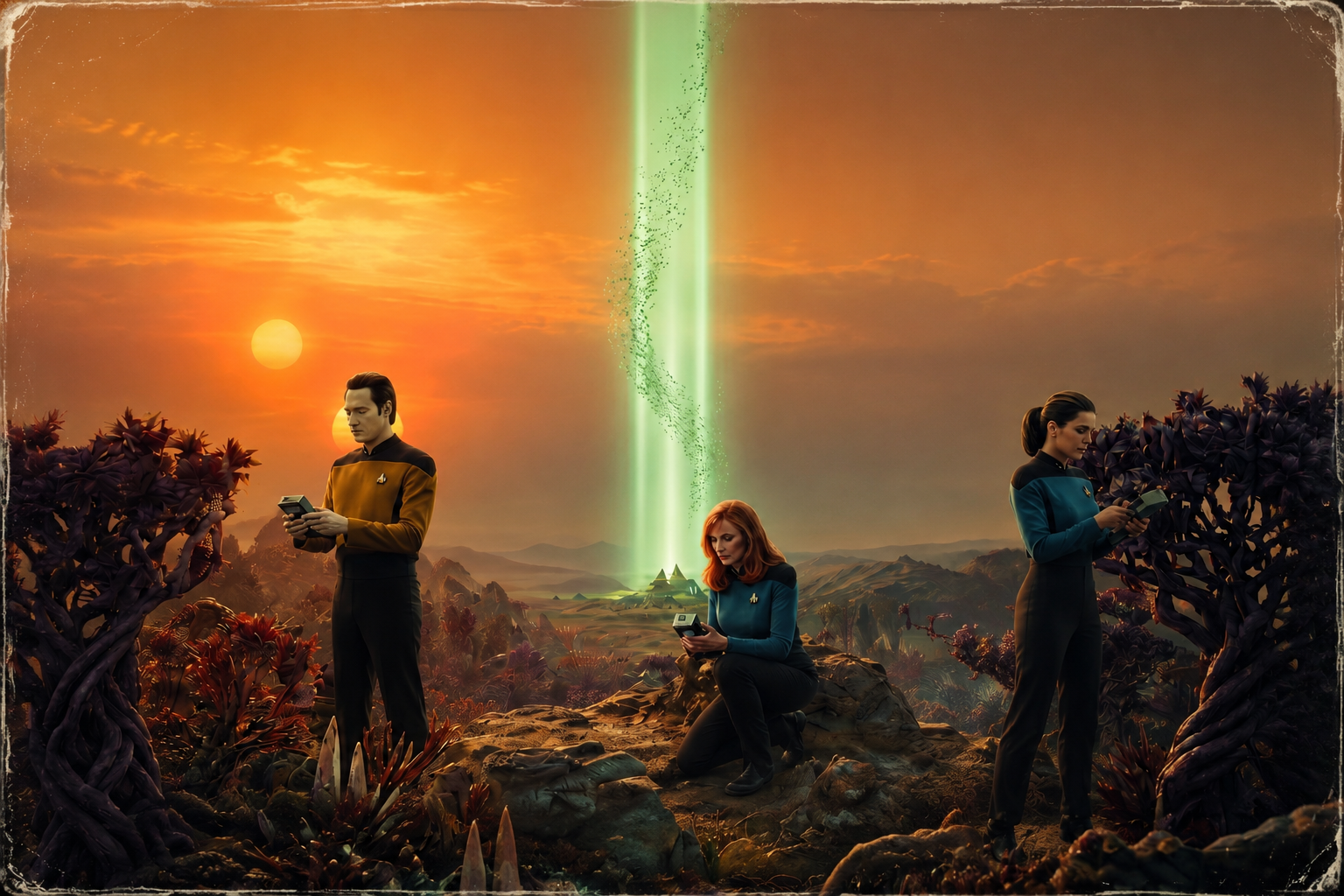
Queen’s Triad happens to take place aboard the Enterprise. The mystery involves a planet, a civilization the crew initially fails to recognize, a distributed biological intelligence, a computer whose behavior raises questions about analysis and authority, and a first-contact problem complicated by the fact that the explorers do not initially understand what they are looking at.
Science fiction makes all of that possible. Yet I could write the same kind of story as a western.
I could place it in the nineteenth century and let a town change because the railroad arrives, not because someone has decided to rob the bank but because the railroad changes land, movement, authority, commerce, time, communication, opportunity and who gets left behind. I could set a story aboard an ocean liner, or inside an archaeological expedition, or in a government office, or in a hospital before antibiotics, or somewhere in Europe a century or two ago where a perfectly rational institution begins encountering evidence that its understanding of the problem is incomplete.
The furniture changes. The thing I am interested in does not.
What is happening here? What do we think is happening here? What evidence would cause us to change that interpretation? Who gets to decide what happens next, and what happens to the people living inside the answer?
Apparently I can spend a very long time with those questions.
The characters had not changed
There was another discovery inside the book that took longer to notice because it felt, at first, like nostalgia.
Writing Queen’s Triad meant spending months with characters I had first met when I was thirteen or fourteen years old. That is a strange privilege. Jean-Luc Picard, Beverly Crusher, Data, Tasha Yar, Geordi La Forge, Deanna Troi and William Riker are not simply fictional characters to me in the ordinary sense. They are people I have been watching at different points in my own life for almost four decades.
The temptation, when returning to something from childhood, is to assume the pleasure comes from finding the thing unchanged. What interested me was almost the opposite.
They had not changed. I had.
At thirteen, I noticed Starbase 74. I noticed the giant doors and the umbilicals and the personnel bridge connecting to the Enterprise. I noticed someone had thought through how a Galaxy-class starship might physically dock inside another structure, and I found that absolutely thrilling.
I still do.
At fifty-two, I also notice the person standing at the transporter console. I notice the engineer working Gamma shift because the ship becomes quieter and certain kinds of thinking become possible only after most people have gone to bed. I notice the teacher who is responsible for children during red alert. I notice that a ship carrying families does not merely possess classrooms as set dressing; it has made an enormous institutional decision about what exploration is supposed to include. I notice Deanna Troi after the emergency, when everyone wants to return to work faster than they are ready to admit what happened to them.
Most of all, I notice Beverly Crusher.
She was never one of the characters I would have named first when The Next Generation originally aired. I liked her, certainly. I understood her place on the ship. Yet it was much later, particularly after seeing the older Beverly in Star Trek: Picard, that I began looking backward and seeing something different.
The younger Beverly stopped looking incomplete to me. She looked unfinished.
That is not the same thing.
Writing her in Queen’s Triad became an exercise in respecting that difference. I did not want to import the woman she would eventually become into the first season and give her forty years of wisdom she had not yet lived. I wanted to look closely enough at the person already there that the later woman remained possible.
So the novel begins with Beverly having saved the ship. The virus is contained. The treatment works. Nobody dies.
Which leaves a question television rarely had enough time to ask: what does the person who saved everyone do when nobody needs saving anymore?
That question became much more important to the book than the virus itself. The emergency ends quickly. The habits built around the emergency do not.
That also became part of what I enjoyed about working inside the unexplained week between episodes. Television necessarily resets certain things. The ship has to be ready for next week. The bridge has to function. The principal characters have to be available. Forty-five minutes allows an event to happen and resolve, but not necessarily enough time for everyone to live through what the resolution actually means.
A novel can remain there.
It can sit beside someone after the quarantine doors open and ask who is exhausted, who is frightened, who is pretending not to be either, who returns to duty too quickly, who suddenly realizes how close something came, and who discovers that being needed has quietly become part of how they understand themselves.
I think that is where Queen’s Triad stopped being an exercise in filling a continuity gap and became something I genuinely needed to write.
A question that refuses to close the argument
Eventually the story found the question that organized almost everything else.
The Maian civilization develops a form of counsel built around three distinct responsibilities. Witness preserves what can be known. Steward considers who will carry the consequences. Threshold protects permission, access, and the right to stop. The Queen must hear all three, but none of them can make the decision for her or quietly become authority in her place.
That structure became the Queen’s Triad. Its central question became: Did it make life better?
The Maian meaning of better is intentionally larger than comfort or efficiency. It includes health, possibility, dignity, relationship, resilience, and whether people retain meaningful choices afterward.
I wrote that question because I have become increasingly suspicious of progress used as its own evidence. We built it, scaled it, automated it, made it faster, reached farther, processed more, and reduced the cost. Those may all be legitimate accomplishments. They still do not tell us what the accomplishment did to the people living inside it.
Did it make life better?
The question does not reject technology, ambition, or exploration. It refuses to allow accomplishment to close the argument. Newer is not necessarily better. Farther is not necessarily growth. More powerful is not necessarily more humane. Asking whether something made life better will not resolve every conflict, but it does prevent achievement from becoming its own justification.
That became a science-fiction idea, although it is very obviously not only a science-fiction idea.
I have spent much of my professional life around software systems, data systems, institutional systems, government systems, and design systems. Increasingly, I find myself less interested in whether a system functions exactly as designed than in what happens to the people living inside it when it does.
Fiction turned out to be another way of asking the same questions. The answer did not need to arrive as an argument. Sometimes it could arrive as a transporter chief moving a landing coordinate twelve centimeters. Sometimes it could arrive as a doctor sitting beside her son because nobody in Sickbay needs her for five minutes. Sometimes it could arrive as a captain realizing that exploration remains valuable precisely because its value must continue to be examined.
Stories let consequences breathe.
The smallest event in the book
The manuscript became much longer than I expected. The world became larger, and the mystery became more complicated. There are first-contact protocols, transporter theory, planetary ecology, computer architecture, orbital mechanics, command authority, families aboard starships, and a civilization that learned to separate knowledge from permission.
Yet the moment I keep returning to is very small.
Near the end of the novel, Beverly Crusher finally reaches a moment in which nobody needs anything from her. There is no patient, no report, no emergency, and no role she must perform. She simply experiences being alive.
The Author’s Note calls it perhaps the smallest event in the book. Then I wrote another sentence: it may also be the reason I wrote it.
I did not plan that ending when I began, and I certainly did not begin with the intention of identifying my preferred narrative form. I found that by following the problems.
That may be what I enjoyed most about writing Queen’s Triad. I did not have to manufacture catastrophe to keep moving. I could let people notice things, let them be wrong without making them foolish, and let another person see something different without turning disagreement into conflict. An answer could solve one problem and create another question. Competence could be interesting. Uncertainty could remain uncertain long enough to become useful.
Maybe that is what slow-burn mystery means to me: not a body on the library floor or the identity of the killer, but a question held open long enough for the world around it to become visible.
I started Queen’s Triad because an episode of television left a week unexplained. I finished it having discovered something considerably less fictional.
Nearly forty years after watching the Enterprise connect itself to Starbase 74, I am still interested in the machinery. I am simply much more interested now in the people standing beside it and, increasingly, in the question they eventually have to answer.
Did it make life better?

Subscribe to Amid the Noise
Amid the Noise is an ongoing body of work on signal, systems, governance, AI, and the structures that shape human judgment under pressure.
Subscribe to receive new essays as they are published.